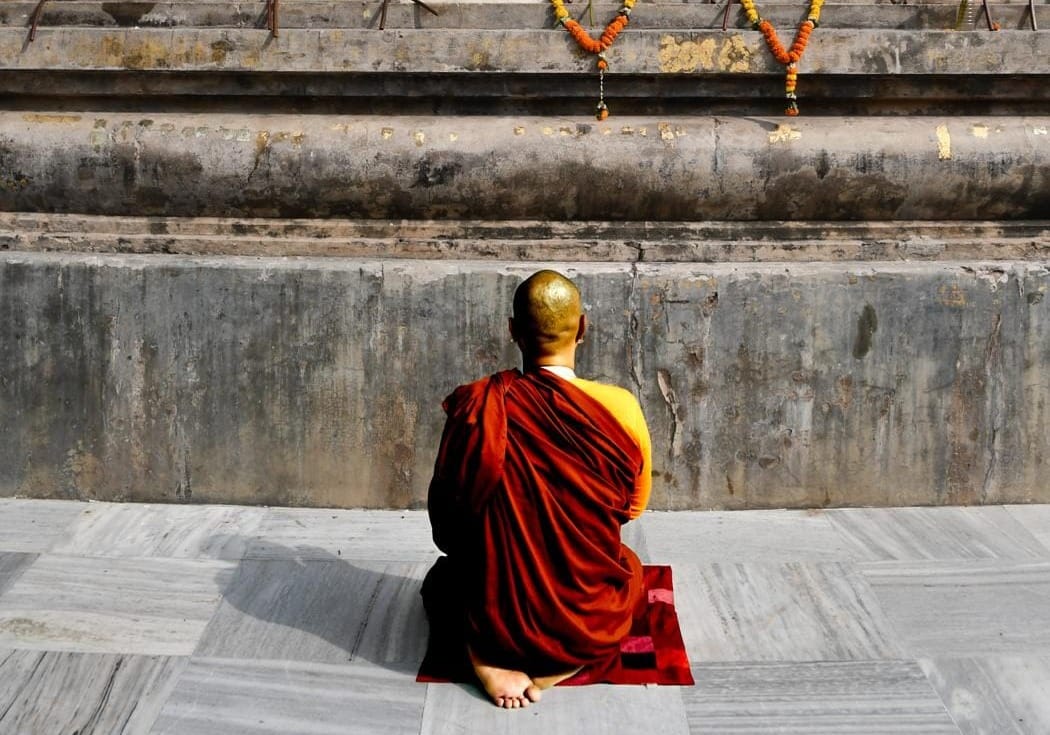
From time to time, I'll post my own travel stories on this blog. The Vipassana experience — 12 days of silent meditation at an ashram in Bodh Gaya, India, in November 2023 — was one of the most profoundly difficult, extraordinary and life-changing things I've ever done (not sure if the 100 mile ultra or this was harder, pretty damn close tbh). I wanted to post my notes in full in case they might inspire someone else to try it.
After the retreat ended, I came out buzzing and poured everything onto the page in a completely unorganised stream, thinking maybe one day it could be a chapter in a book about surviving grief through gratitude. These are those notes, cleaned up just enough to read but left raw on purpose. This is Day 1. I'll group the rest together as a series, so if you're thinking about doing a Vipassana — yes, do it.
Here is some on the first day...
We arrived at the city of Bodh Gaya, India in the early evening. Kirsten and I, seven months after the worst night of our lives, stepping off a plane into a place where Siddhartha Gautama became the Buddha about 2,500 years ago. Not that I was thinking about enlightenment. I was thinking about the guy three rows ahead of me.
He was throwing major monk vibes. Tall. Shaved head, well-worn T-shirt with a quote about compassion that I couldn't quite read. His only possessions appeared to be a yoga mat and some contents which fit into an old cloth rice sack. His sandals had distinct tan lines around his feet that told you everything — this man had been walking for a very long time, in very hot places, with very few things. The term spiritual warrior came to mind. Every movement was slow, deliberate, made with the kind of thoughtful contemplation that suggested he'd been doing this for years, not performing it for the flight. After he left the plane, I didn't think too much more about him.
Then we stepped outside.
Bodh Gaya hit us immediately. Not the spiritual significance of where we were, but the absolute sensory assault of the place. It's dusty, it's hot, the horns are blaring, bikes whizzing by in both directions, cows walking dead centre in the middle of the street like they own the place (they do, legally), street beggars shoving their hands into your face, dogs sleeping 3 or 4 feet into the road with buses driving full speed around them. All of this happening at double time speed. And amazingly, it just works. If this were any other place on the planet, there would be a crash every 100 meters. If I were on a motorbike — and I grew up driving one in Bermuda since the age of 12 (not legally) — I'd be in one of those accidents because there's no rhyme or reason to any traffic obligation. You just need to have lived and breathed this type of driving experience since birth to know how it works.
By intuition and feel, I guess. Like a lot of things in India.
Immediately upon our exit from the airport we were thrown into a two-tiered system of what I'd call street hustlers and then tok-tok drivers who bicker amongst themselves to get your service. The hustlers work the front line — better English, bigger smile, 10x the real price. The tok-tok drivers wait behind them for the leftovers.
I knew how this worked because I'd already been that doh-doh European who got grifted for this exact hustle in Delhi.
That story is worth telling. I had arrived in Delhi thinking one of my software developers was going to pick me up. He wasn't there. I had no data plan yet. One of these grifters offered me a hotspot off his phone, then I asked how much for a cab into the city. He told me the price in Rupee. I'm just in the country, didn't take the time to understand how much things cost, the FX to my home currency, and think — OK, $40 doesn't sound that unreasonable for an hour-long cab ride.
Grift made.
I was later laughed at by my teammate, who informed me that the real cost should be $3 or $4, and that the amount I had paid to this grifter — who didn't even drive me himself — was as much as some of the villagers in his hometown spend in a month.
Well, that kind of stings.
Armed with this experience, I brushed off the first wave of hustlers in Bodh Gaya and walked straight into the bidding war of tok-tok drivers. Without me even saying what address I was going to, the bidding started at 500 rupees but like a cattle auction in reverse, the drivers were bidding against each other, yelling at me — 450, 350, 300, 250, 200. I'm standing back only smiling, thinking these guys don't even know where I'm going yet. I point my finger to the chap who bid 200. He makes the silent claim amongst the dejected faces of the other drivers and we walk to his tok-tok where we meet another western traveller already seated in the cab.
So he's already made 200 from this guy, had him in the bag, and could bid 50% cheaper than everyone else. Clever.
The drive into town didn't disappoint. This was exactly what Kirsten and I were looking for. It's the kind of intensity that makes real travel interesting. It's more than just a slightly different version of what you're used to. This is like entering a different reality. A different planet.
The first night's stay was unremarkable. But we wanted to visit the Mahabodhi Temple — the actual site where the Buddha was enlightened. I mean, this is a significant human event, one of the most significant in history, and we happened to be in that location. Who wouldn't want to see it?
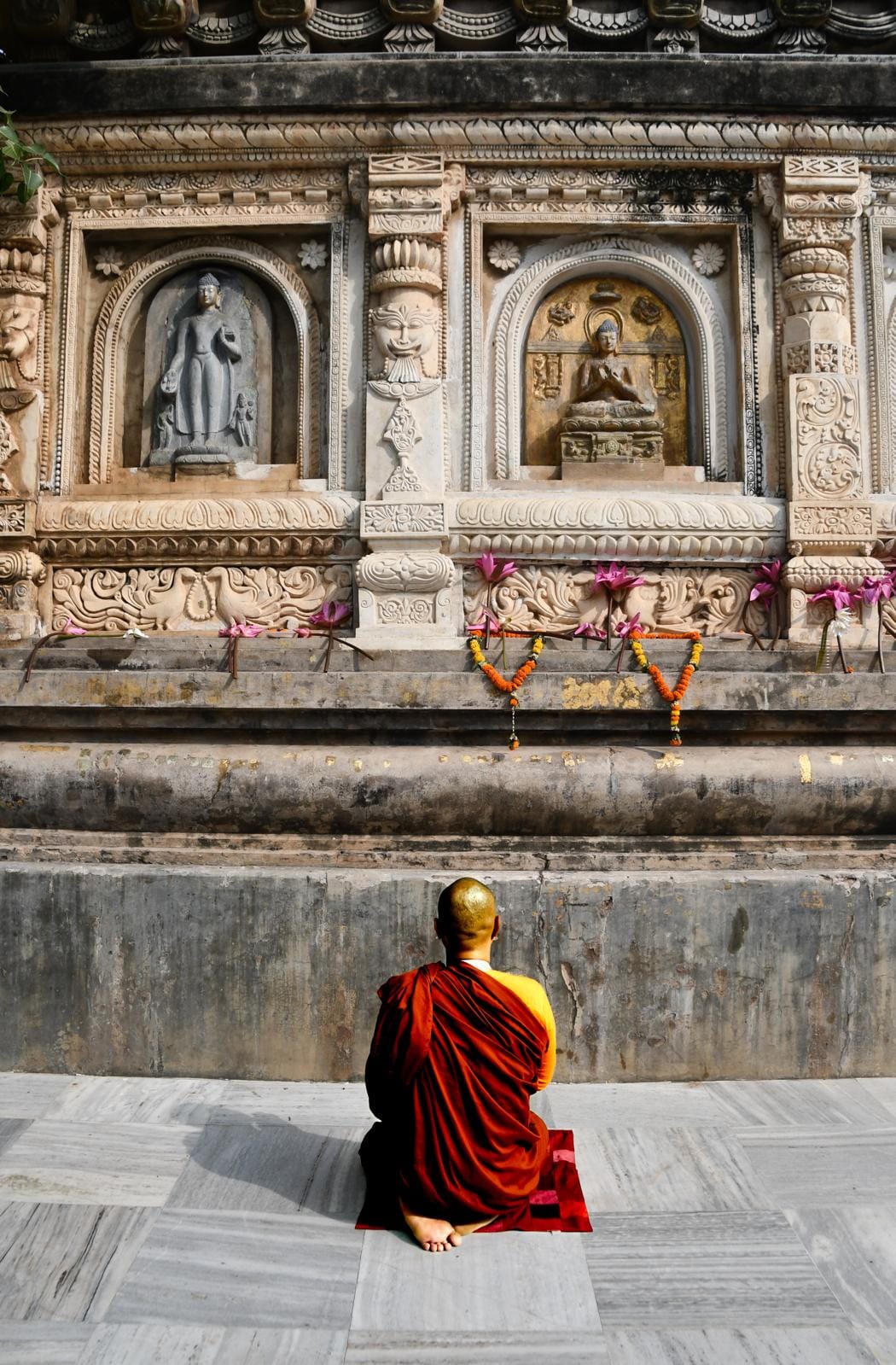
Apparently, there's another grift that somehow I also fell for. Yes, I know, there's a theme with me being hustled. Maybe I don't have great street smarts, or I'm simply too trusting of a person. This guy came into our tok-tok claiming to be an ex-monk. He showed me a picture of a monk in robes that looked about 10 years younger than him (of course, people with shaved heads all kind of look the same). He showed us around the temple and he knew his stuff. But this guy had been well rehearsed grifting overly trusting western tourists. The play is the same everywhere — he takes you to his "friend's" store, they show you some merchandise, mark up the price by 10x. He's been so nice, he's just taken 2 hours of his time to show you around town, says he's a monk, you trust him, you think in terms of what things would cost back home, shrug, and pay the man.
Then you find out the real price of those beads wasn't $70. It was $6.
Then you're furious at yourself for being hustled. Again.
The grift could have been much worse. Part of his story was that he had an orphanage. He showed us pictures of him feeding orphaned children — all staged, all part of the act — and then talked about taking us there after the visit to his friend's shop. I had even been thinking, oh what a great cause, I could probably wire this guy $200 for his orphanage. At least I would know it was going directly to the children.
Sheesh. His mistake was going for the small ticket grift. He got me on some beads instead of the bigger play, which could have been a few hundred wired to his account as the fake orphanage. Maybe even annually.
He showed up at our hotel the next morning. He knew we were heading to the Vipassana centre — anyone doing a silent retreat is probably falling on the more woke, compassionate side of a hustle. The hotel concierge quietly pulled me aside and said: do not go with this man. He's a very bad man.
Great. That's just what I was thinking.
We got a $1 tok-tok to the Vipassana centre instead.
Kirsten and I walked through the gates of Dhamma Bodhi apprehensively. On the way in, a street vendor was selling odds and ends that seemed like they'd be useful during the stay. I purchased some soap — thank goodness for this, because otherwise I would have had no soap during my entire stay — and some cookies, thinking the treats inside were probably sparse and you never know when you might need a pick me up.
We wanted to arrive early enough to meet some of the people we'd be spending the next 12 days with. Without speaking.
The first person I met was my roommate. I called him Don Quixote because he was exactly what you would imagine Don Quixote to look like if you had seen a book cover of a thin stick figure drawing of the character in an airport someplace, somewhere, ten years ago. Tall-ish, thin, a bit gaunt, greying trimmed beard, bespectacled. You could have taken off the glasses and put him in an old tin pot knight kit and he would have looked exactly right charging windmills somewhere in the Sierra Madres. He was from Madrid. I told him my son was going to University there and that it was one of my favourite cities in Europe. All true. We discussed the aspects of the University and the town, and that was the last conversation I had with a person I would spend very close contact with for the next 12 days.
Then there was the Gaucho. I met him briefly in the food hall before we had to go in for our first dhamma meeting. He explained how he'd just spent 3 months volunteering at a refugee hospital in Nepal, and before that, another 3 months travelling India. His only skills, he claimed, were that he could speak English, Spanish and Hindi equally fluently. I called him the Gaucho because he had this supreme flamenco Latino air. Short, good-looking, interesting tattoos on his hands and arms that gave him a bit of a gipsy groove, but what really got me was his masterful eye for being a nomadic Latino traveller. A mix of Peru, Guatemala, Nepal and India all put together to give the impression that he should be sitting by a campfire in the Andes, laughing with his mates as horses nervously bantered in the Argentinian wilderness. I have fond memories of the Gaucho walking calmly through the Indian early morning mist, a Peruvian or Nepalese throw rug swept gracefully across his shoulder. The name stuck.
The Cheater was memorable because he brazenly broke the Dhamma rules right in front of everyone. Unzipping his pouch and munching on outside food (strictly forbidden) in the middle of a silent meditation. He looked the part of a philosophy professor at a UK University — John Lennon specs crossed with Professor Calculus from Tintin, matching linen yoga outfit, yoga-like bag slung over his shoulder. He would whip a pen out during meditation discussions and jot notes down on his hand. Like a cheating high schooler taking an exam. I never caught his actual name before we all went quiet.
And the clothes. It was almost like every single person in camp went to some type of yoga and meditation shop in Delhi and asked for clothes that would be cool, loose-fitting and easy to sit in for 15 hours per day. They all had it. Except for me.
By the time the opening ceremony came around that evening, 140 of us shuffled into the Dhamma Hall not knowing what to expect. We were told to find our number on a yellow tag, locate our meditation mats, sit down, and quietly wait. The meditators were organised by seniority — veterans up front, the newbie fresh minds (my class) in the back.
Then it happened.
The singing started, at first almost imperceptibly, like I wasn't sure what was going on or where it was coming from. Then the two head teachers walked in. The lights behind them gave them a near deity-like backlighting. The one on my side of the hall was already dark-skinned, but in the semi-darkness and with that saintly glow coming from behind him, he may as well have been the Buddha himself. He walked up, complete with a crisp white men's skirt, folded his legs quickly and easily underneath him, and sat down with the most immaculately perfect meditation posture I had ever seen. Glowing backdrop, perfectly straight back, arms neatly connecting to his knees. He didn't do the classic mudra, the thumb to forefinger O-shaped hold. He simply let his hands drop naturally. And he didn't move.
I mean he did not move. Ever.
In the countless hours over the next 12 days that I would secretly sneak a peek at him during the long meditations to see if he was subject to the natural human abhorrence to holding this posture for so long — I never saw it. Not once. In over 180 hours of him sitting this way.
He was like a god to my fresh, innocent, recently-grifted-twice mind. I was like a baby looking at his father in awe.
The first time I heard TEO — The Enlightened One, the recorded voice of S.N. Goenka who guided all the meditations — his singing sounded so strained, so deep, and almost painfully bad that I didn't think it could be real. Like, how could anyone think they had the right to sing or chant with such terrible singing chops? It took something deep within me, perhaps skills long fought over and since deployed during my middle school years, to not break into a majorly embarrassing giggle fit in front of 140 silent meditators on my very first night.
I survived the giggling. Barely.
I went to bed that night with a clean slate, ready to start what would be the most exhausting, painfully gruelling experience of my life.
The schedule they handed us said everything I needed to know. 4:00am wakeup. 4:30 to 6:30, morning meditation. Breakfast. More meditation. Meditation. Lunch. Meditation. More meditation. Tea. Even more meditation. Discourse. Final meditation. Bed at 9:30.
Roughly 12 hours of meditation a day. For 12 days. In a country where I'd already been hustled twice and I didn't even own the right pants.
My wife was somewhere on the other side of a wall, about to do the same thing, and neither of us would be allowed to say a word to each other until it was over.
I closed my eyes. The bed was hard. The room was hot. Somewhere outside, a dog was barking on a street in Bodh Gaya, probably sleeping 3 feet into the road, probably fine.
We were in India. We were doing this.